
4.7 Stimulus Equivalence Example Part 1
Let’s look at a phenomenon known as stimulus equivalence. Stimulus equivalence involves deriving relations of sameness or equivalence and is often studied in the laboratory with arbitrary symbols like these1. First, a person learns to match one arbitrary visual stimulus (A) to another (B). The stimuli are not actually labeled A and B in the experiment, silly. Whenever stimulus A is presented at the top, picking stimulus B is reinforced.
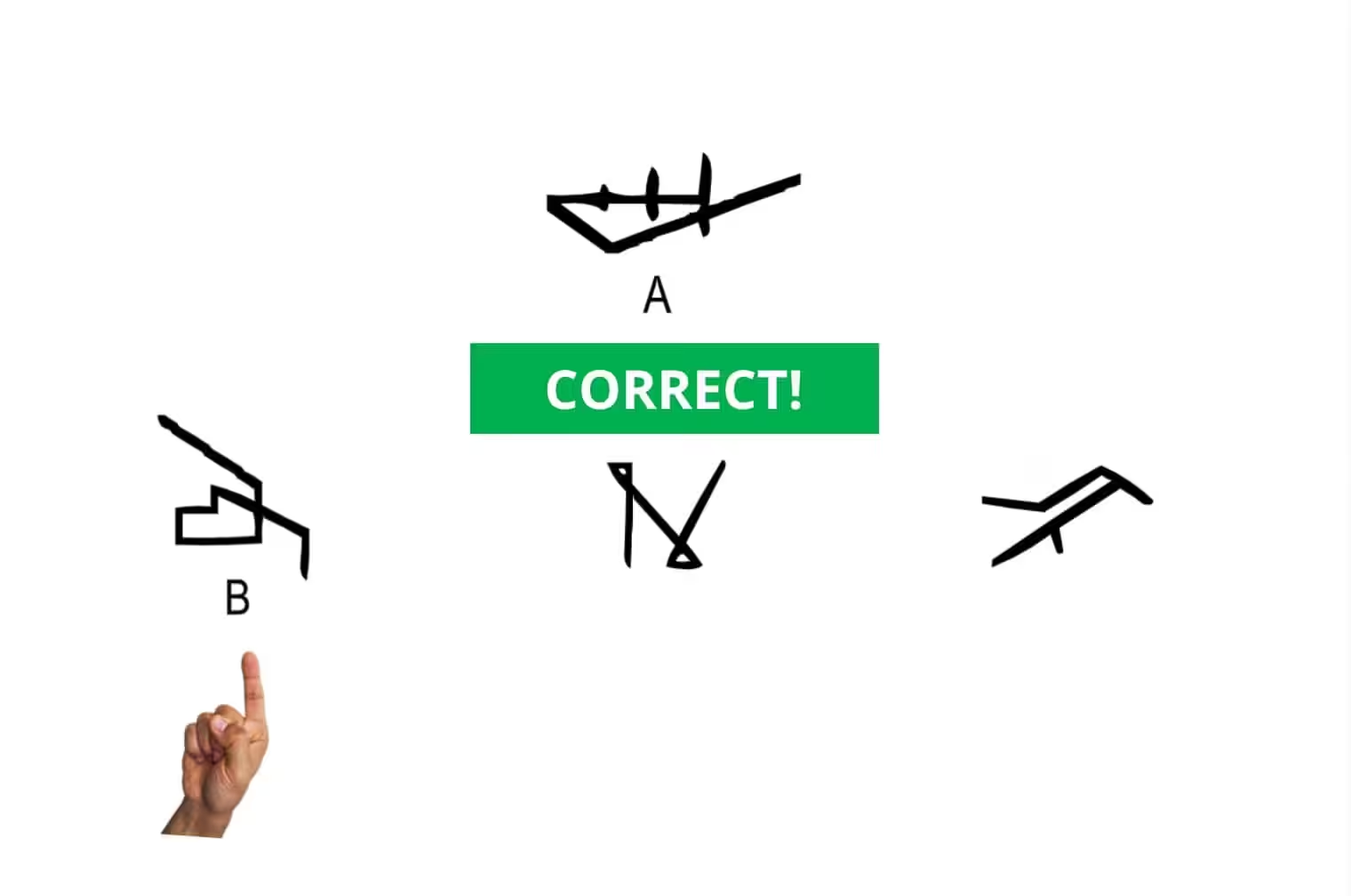
- Barnes-Holmes, D., Barnes-Holmes, Y., and Smeets, P. M. (2004). Relational frame theory and stimulus equivalence: Conceptual and procedural issues. International Journal of Psychology and Psychological Therapy, 4(2), 181-214.
Silly?
I don’t see the match between A & B.
The symbols representing A and B in the example are not meant to match in physical properties. The idea is that because A was presented, the correct option is B because you were reinforced that the symbol A matches the symbol B, even though they do not match physically. An example I think of is if I was learning another language, lets say Spanish, and I was taught that, “casa” is “house”. Then in the example “Casa” would be A, and “house” would be B. This relation is equivalent and is not based on physical properties.
Great explanation. Thanks!