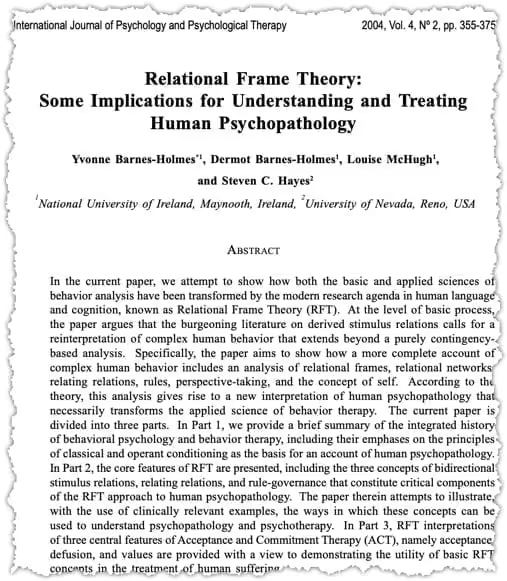
Relational Frame Theory: Some Implications for Understanding and Treating Human Psychopathology | 1.5 BCBA CEUs
$14.99
BCBA CEUs: 1.5 CEUs
Read the following article and pass an 8-question quiz on it:
Barnes-Holmes, Y., Barnes-Holmes, D., McHugh, L., & Hayes, S. C. (2004). Relational frame theory: Some implications for understanding and treating human psychopathology. International Journal of Psychology and Psychological Therapy, 4, 355-375.
 14 Star Points (worth a $1.40 discount) when you purchase this product!

Description
To earn credit, you will be required to read the article and pass an 8-question quiz about it. You can retake the quiz as many times as needed, but you will not receive exactly the same questions each time.
Abstract
In the current paper, we attempt to show how both the basic and applied sciences of behavior analysis have been transformed by the modern research agenda in human language and cognition, known as Relational Frame Theory (RFT). At the level of basic process, the paper argues that the burgeoning literature on derived stimulus relations calls for a reinterpretation of complex human behavior that extends beyond a purely contingency-based analysis. Specifically, the paper aims to show how a more complete account of complex human behavior includes an analysis of relational frames, relational networks, relating relations, rules, perspective-taking, and the concept of self. According to the theory, this analysis gives rise to a new interpretation of human psychopathology that necessarily transforms the applied science of behavior therapy. The current paper is divided into three parts. In Part 1, we provide a brief summary of the integrated history of behavioral psychology and behavior therapy, including their emphases on the principles of classical and operant conditioning as the basis for an account of human psychopathology. In Part 2, the core features of RFT are presented, including the three concepts of bidirectional stimulus relations, relating relations, and rule-governance that constitute critical components of the RFT approach to human psychopathology. The paper therein attempts to illustrate, with the use of clinically relevant examples, the ways in which these concepts can be used to understand psychopathology and psychotherapy. In Part 3, RFT interpretations of three central features of Acceptance and Commitment Therapy (ACT), namely acceptance, defusion, and values are provided with a view to demonstrating the utility of basic RFT concepts in the treatment of human suffering.
Additional information
| Format | Article Quiz |
|---|---|
| Type of CEU | General |
| Total CEUs | 1.5 |
| Reading Time | 1 hour 26 minutes |
| Publication Date | Aug 17, 2013 |
|---|---|
| Last Updated | Dec 8, 2025 |
Add a review
You must be logged in to post a review.
Questions & Answers
You may also like…
-
Article Quiz
Establishing a Deictic Relational Repertoire in Young Children | 1.5 BCBA CEUs
 (21)$14.99 Add to Cart
 -
Multimedia Tutorial

An Introduction to Relational Frame Theory (RFT) | 7 BCBA CEUs
(520)$69.99 Add to Cart -
Article Quiz
Relational Frame Theory and Skinner’s Verbal Behavior: A Possible Synthesis | 1.5 BCBA CEUs
(18)$14.99 Add to Cart






20 reviews for Relational Frame Theory: Some Implications for Understanding and Treating Human Psychopathology | 1.5 BCBA CEUs
Customers generally found the article on Relational Frame Theory to be highly informative, interesting, and a valuable resource for clinicians in ABA. Many appreciated its detailed content and the practical, far-reaching implications for understanding and treating psychopathology. While some mentioned specific preferences for writing style or personal relevance, the overall reception was overwhelmingly positive.
Customer reviews