Introduction to Molar Behavior Analysis | 1 BCBA CEU

$9.99
BCBA CEUs: 1 CEU
Read the following article (reading time: 50 min) and pass a 9-question quiz on it:
Baum, W. M. (1995). Introduction to molar behavior analysis. Mexican Journal of Behavior Analysis, 21 (3), 7-25.
 9 Star Points (worth a $0.90 discount) when you purchase this product!
Description
To earn credit, you will be required to read the article and pass a 9-question quiz about it. You can retake the quiz as many times as needed, but you will not receive exactly the same questions each time.
Abstract
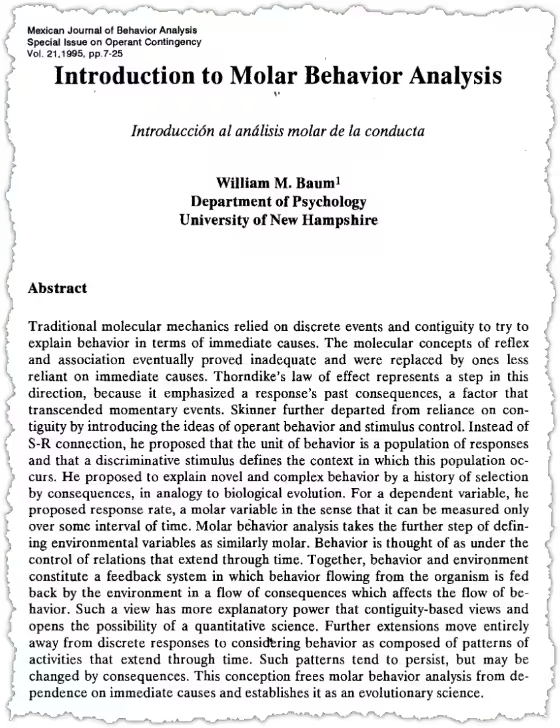
Traditional molecular mechanics relied on discrete events and contiguity to try to explain behavior in terms of immediate causes. The molecular concepts of reflex and association eventually proved inadequate and were replaced by ones less reliant on immediate causes. Thorndike’s law of effect represents a step in this direction, because it emphasized a response’s past consequences, a factor that transcended momentary events. Skinner further departed from reliance on contiguity by introducing the ideas of operant behavior and stimulus control. Instead of S-R connection, he proposed that the unit of behavior is a population of responses and that a discriminative stimulus defines the context in which this population occurs. He proposed to explain novel and complex behavior by a history of selection by consequences, in analogy to biological evolution. For a dependent variable, he proposed response rate, a molar variable in the sense that it can be measured only over some interval of time. Molar behavior analysis takes the further step of defining environmental variables as similarly molar. Behavior is thought of as under the control of relations that extend through time. Together, behavior and environment constitute a feedback system in which behavior flowing from the organism is fed back by the environment in a flow of consequences which affects the flow of behavior. Such a view has more explanatory power that contiguity-based views and opens the possibility of a quantitative science. Further extensions move entirely away from discrete responses to considering behavior as composed of patterns of activities that extend through time. Such patterns tend to persist, but may be changed by consequences. This conception frees molar behavior analysis from dependence on immediate causes and establishes it as an evolutionary science.
Additional information
| Type of CEU | General |
|---|---|
| Format | Article Quiz |
| Total CEUs | 1 |
| Reading Time | 50 minutes |
| Publication Date | Jun 28, 2026 |
|---|
Add a review
You must be logged in to post a review.







1 review for Introduction to Molar Behavior Analysis | 1 BCBA CEU
Customer reviews